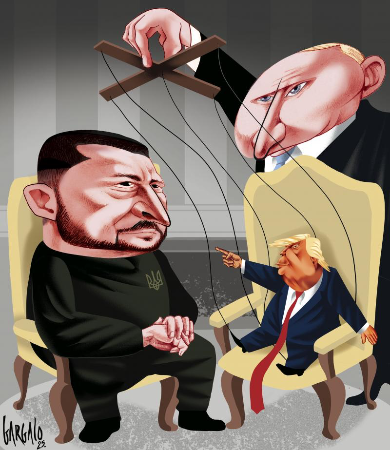
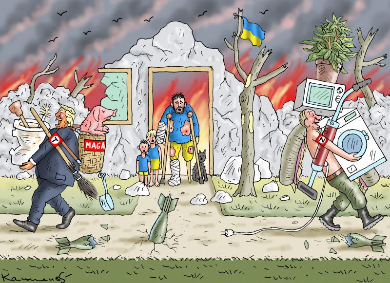
Satire and humor as one of the dimensions of real and discursive analysis of armed conflicts
Mocking, ridiculing and joking are now common ways of describing and commenting on social and political phenomena. Political humor, meme-making has become a form of political discourse. But can we talk about a serious armed conflict and comment on it in this way?
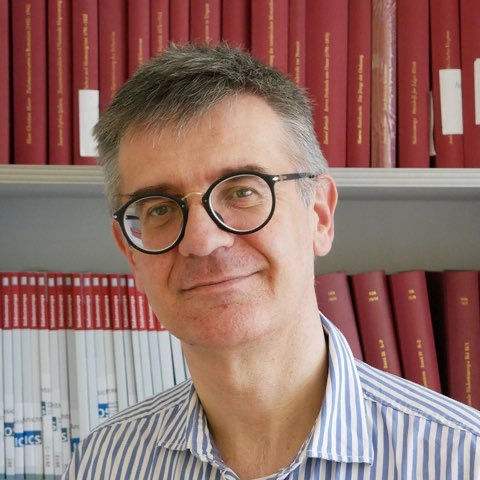
Dr. Orest Semotiuk, originally from Ukraine, heads the project entitled “Humoresearch. Laughter during the war: Russian aggression in Ukraine in political cartoons and memes”, tries to answer this question. As a researcher who was forced to leave his homeland due to the war, he can continue his research at the Institute of Slavic Studies of the Polish Academy of Sciences thanks to the Polonez Bis program.
The purpose of the Humoresearch, according to Dr Semotiuk, is to explore the inherent interdisciplinarity of humor. The starting point for his research, conducted in Poland, is the assumption that modern wars differ from classical ones in that they use not only military equipment and regular troops. Values, ideology, culture, symbols, media, humor have become weapons in the 21st century.
As Orest explains, the objective of his research is to investigate the discursive dimension of the Russian-Ukrainian military conflict which began in 2014 and escalated on 24.02.2022 after Russian full-scale invasion in Ukraine. His project aims to analyze the implementation and evolution of the actual dimension of the Ukrainian-Russian military conflict in political humor (cartoons and memes), taking into account the parameters of target, focus, social acceptability, presentation, and context.
The project explores how logical reasoning about the Russian-Ukrainian war is reflected in political humor, focusing on the connection between real-world conflict and its portrayal in discourse. It examines how international military-political assistance to Ukraine is mirrored in both national and international political humor. This correlation is determined by the fact that political humor in the Russian–Ukrainian War operates in two registers: first in support of Ukraine on the international level), and second, as an invitation to foreign audiences to see the fairnessof the Ukrainian cause on the national level. The project is both multidimensional and multicultural. The corpus combines both traditional and modern genres of political humor (6000 cartoons and memes) from North and South America, Australia, Afriсa, Asia, and Europe (65 countries), represented by the largest number of cartoons and cartoonists. The project is based on „conceptual pragmatism“ and combines theoretical and empirical approaches with quantitative and qualitative methods regarding the social context.
Dr Semotiuk and his team have applied the results of their research in several impactful ways. They have broadened the scope of Slavic studies to include cross-cultural aspects, enriched the set of methodological tools of media linguistics, and introduced a modern approach to scientific use that is relatively new among Ukrainian scholars. The project aimed to explain how media linguistics can be linked to other disciplines (social anthropology, discourse and humor studies, political communication) and identify the added value it brings to these disciplines.
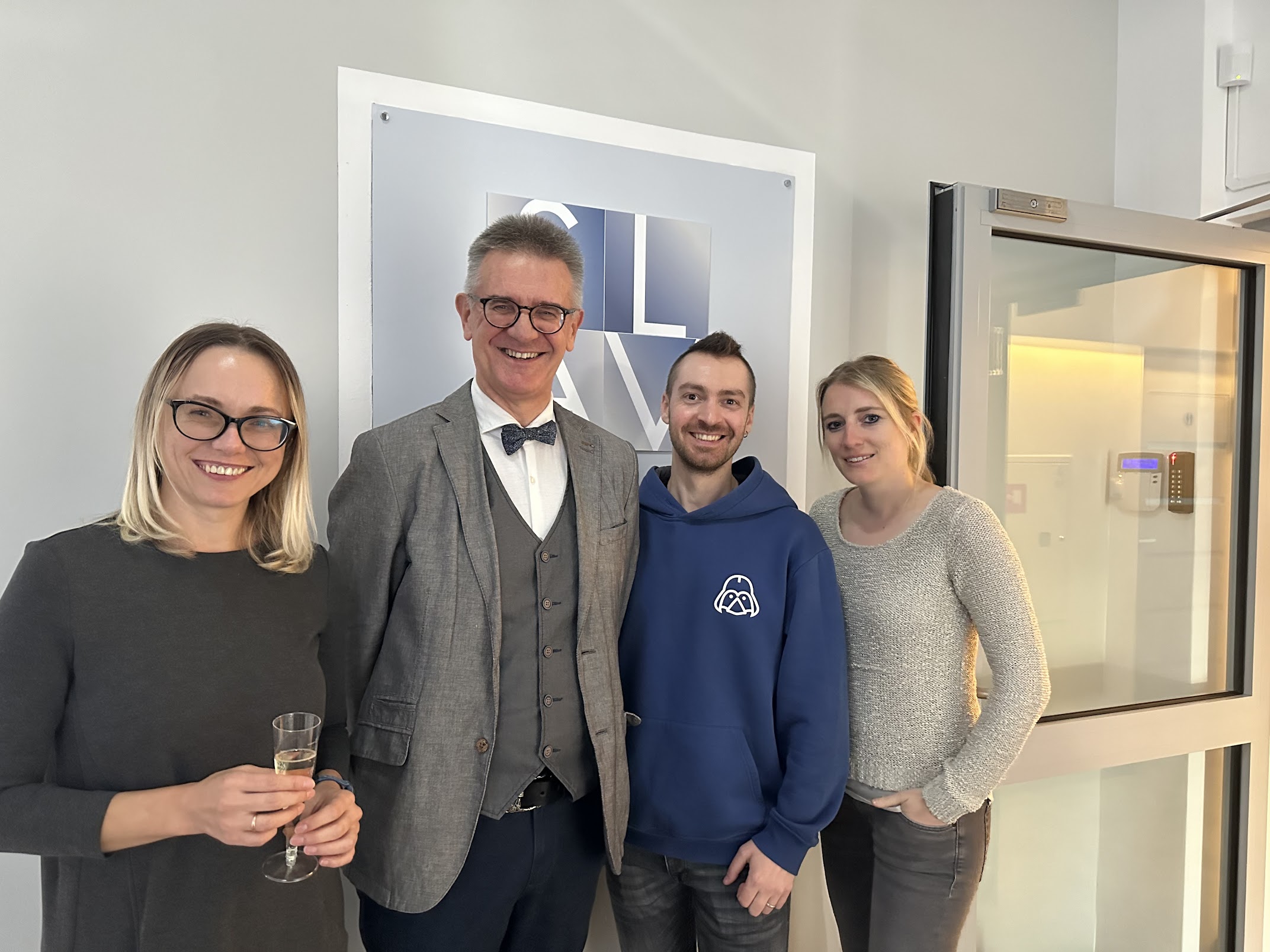
Source: private archive of Dr Orest Semotiuk,
In the photo Dr. Olha Tkachenko, former director of the Scientific Research Service Center at the Institute of Slavic Studies of the Polish Academy of Sciences, now an adiunkt at the institute, Dr Semotiuk, Dr Anton Dinerstein and Dr Anna Becker- principal investigators of other projects within the Polonez Bis program
During the project implementation, the research results were presented at many conferences and meetings in Poland and around the world: France, United States, Estonia, Germany, Great Britain. The project website (https://humoresearch.ispan.edu.pl/) also features a blog providing a commentary on current events related to the Ukraine-Russia conflict. . The blog entries are accompanied by satirical images, which are one of the main subjects of research conducted by Orest’s team.